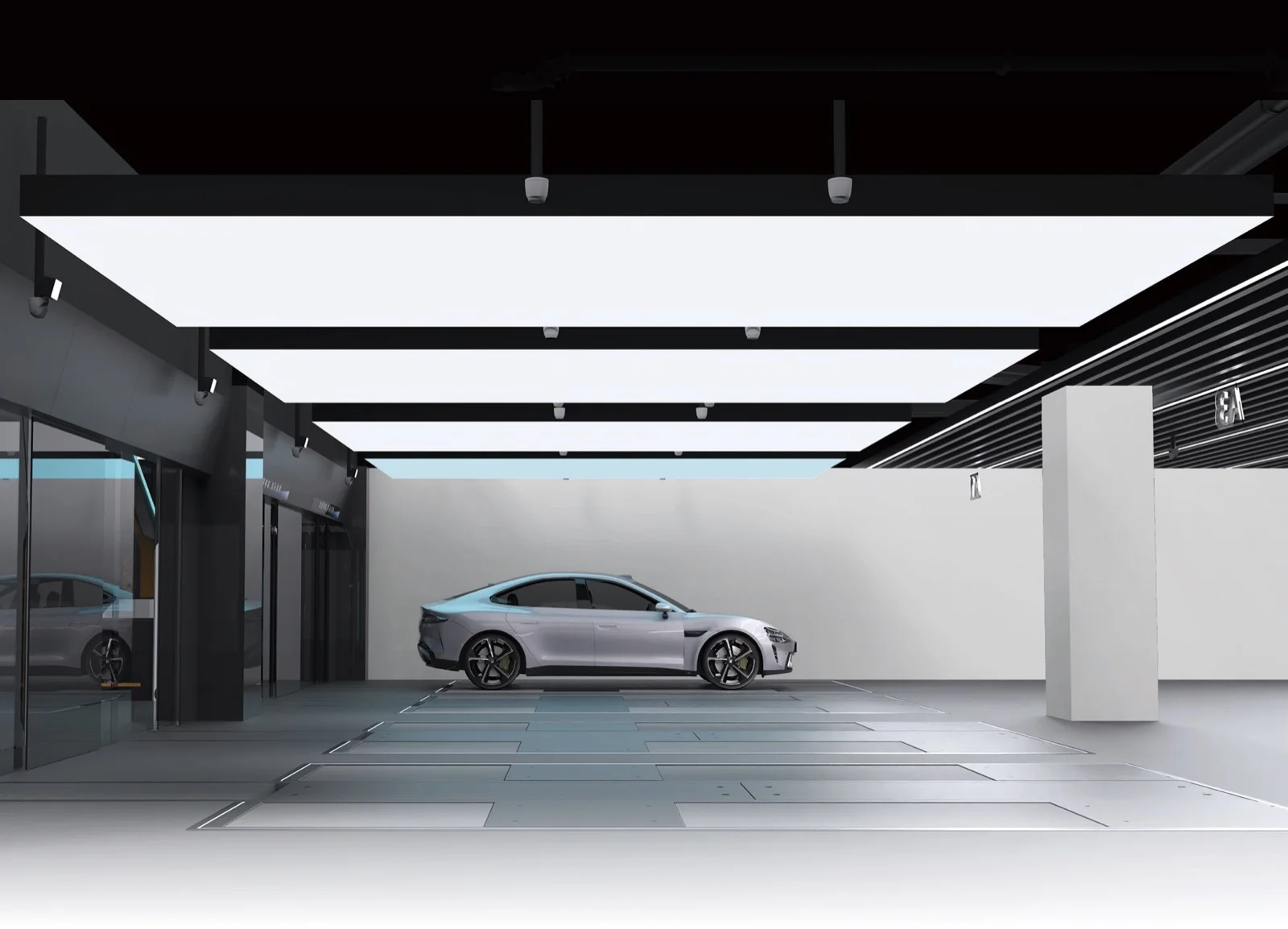
If a vehicle can drive itself, why does a human still have to park it and plug it in?
We've asked a version of this question before, about ports and logistics depots running autonomous charging today. The answer, until recently, was that autonomous charging and autonomous parking were solved by two separate machines that didn't talk to each other. A robotic arm could connect a cable. Getting the vehicle into position first was still somebody's job.
That gap has closed. A fleet of driverless logistics vehicles already completes the entire cycle with no human step at any point: the vehicle finishes its route, returns to base under its own control, is received and stacked by a robotic parking system, charges automatically through a connector that rises into its underbody, and re-deploys when needed. As far as we're aware, this is the first commercial deployment anywhere in the world where a driverless vehicle's parking and charging are both handled without a person involved at any stage.
The point isn't the demonstration. It's that the underlying system, robotic parking plus automatic charging plus scheduling AI, doesn't care whether the vehicle arriving is driven by a person or by software. Build it once, and it serves both.
The platform behind it is called StackCharge, delivered in the UK exclusively by Neutron Systems, covering site design, installation, compliance and aftercare. It was developed by TGOOD Group, parent company of Telaidian, the world's largest public EV charging network operator, first globally in both public charging points deployed and annual charging volume.
Most UK sites don't need a driverless fleet to have this problem
Depot land, town-centre car parks and mixed-use basements in UK cities are priced at a premium, and every square metre lost to ramps and drive aisles is a square metre not earning revenue. Add EV charging into that same footprint using conventional methods, and operators are often choosing between parking capacity and charging capacity on the same scarce land, or funding a multi-storey basement, excavation, ventilation, fire strategy, that's slow and capital-intensive before a single car is parked.
StackCharge treats parking, charging and space efficiency as one problem, solved by one machine.
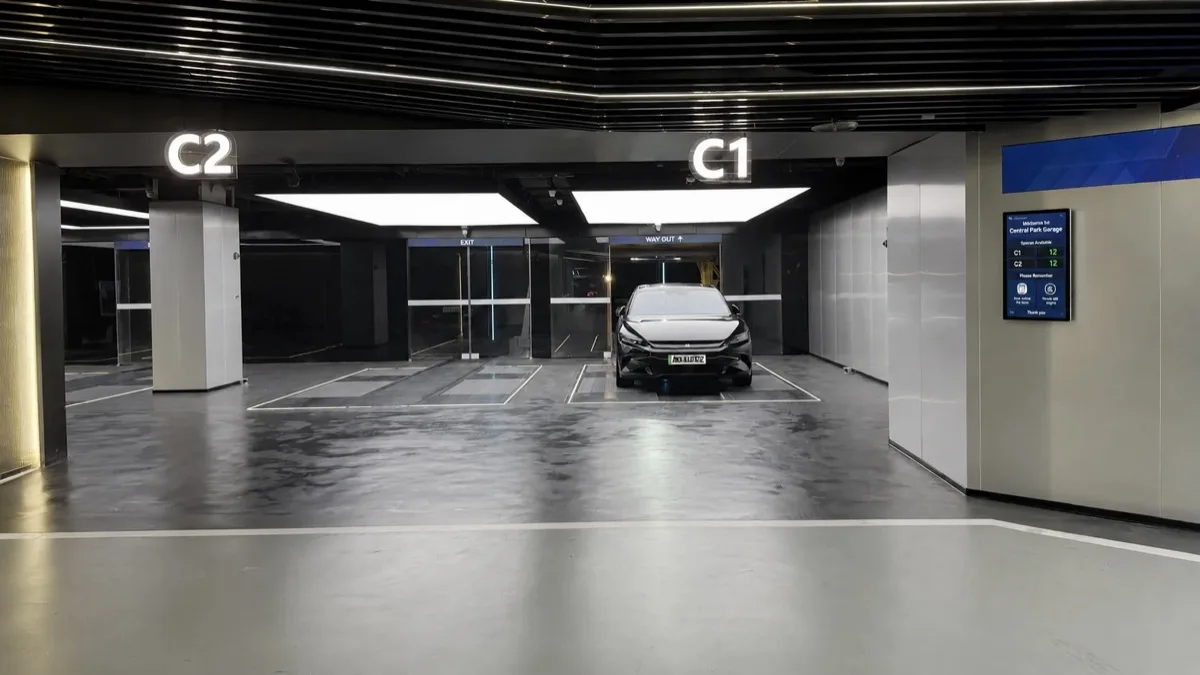
A vehicle arrives at a StackCharge bay. Live bay availability is shown on-site; positioning and storage from this point are automatic.
Three parts, one automated cycle
StackCharge runs on three components, working together with no human step between them.
The parking robot. A shuttle vehicle lifts, transports and turns each car onto a precision-engineered three-tier stacking frame, using a rigid-chain lift and full-torque servo drive rated to millimetre-level positioning. There are no pallets to line up against, no barriers, and no reversing or repositioning required, whether the vehicle is human-driven or autonomous.
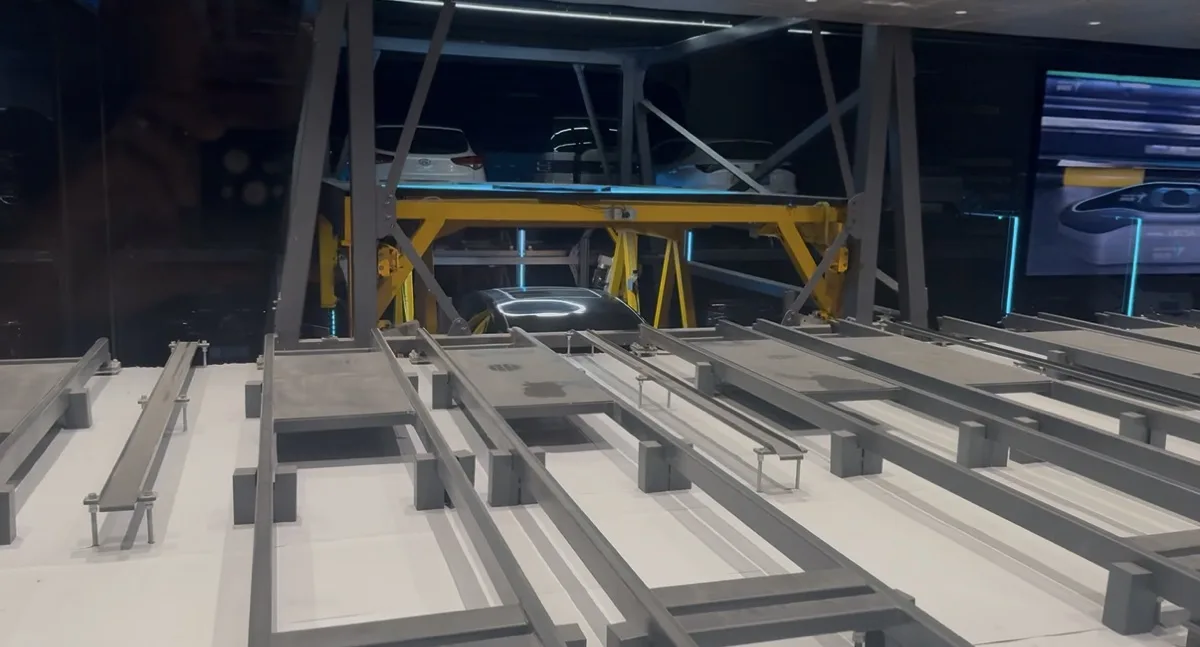
The chain transfer unit moves a vehicle onto its storage position along a precision rail frame.
The charging robot. Every bay can carry an Automatic Charging Dock (ACDU) beneath the vehicle. A connector rises from the floor, self-aligns to the vehicle's underbody charging port, and completes a contactless, camera-verified DC fast-charging session, monitored live by battery-management telemetry. There is no cable for a driver to plug in and nothing for a human to check.
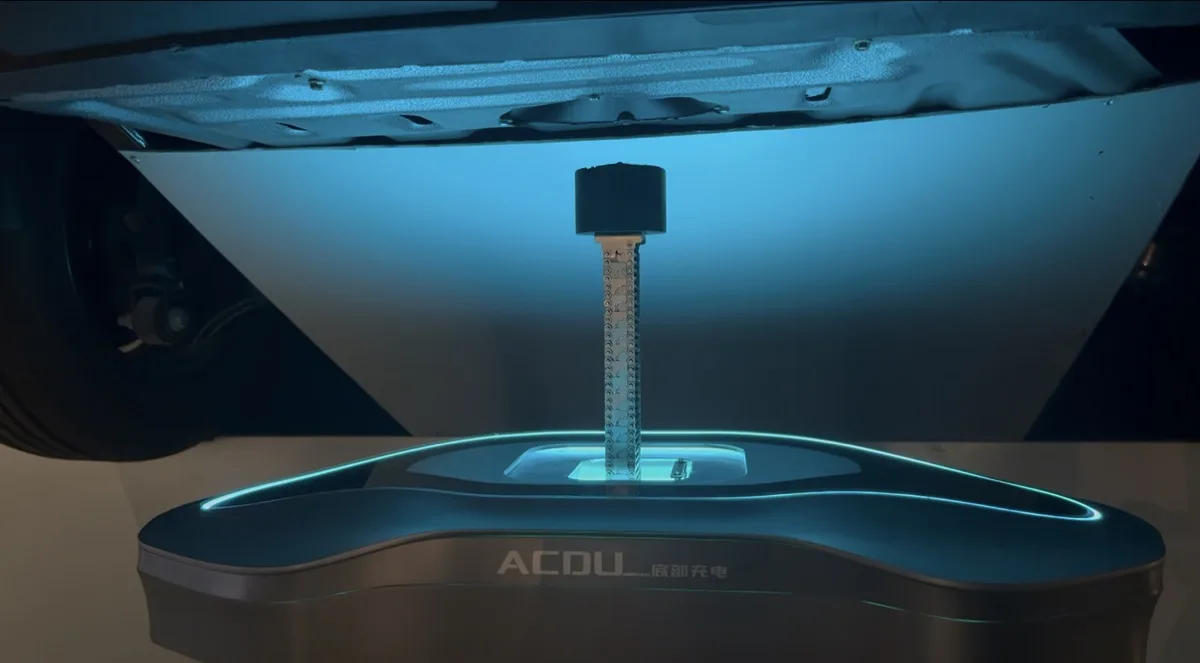
The Automatic Charging Dock (ACDU) rises to meet the vehicle's underbody charging port. No cable, no driver action.
On rail-served rows, an ACDU unit can also travel between bays rather than sitting fixed beneath one, in the same way a single rail-mounted arm can serve multiple charging bays in our port and logistics deployments. The economics follow the same logic: fewer charging units doing more work.
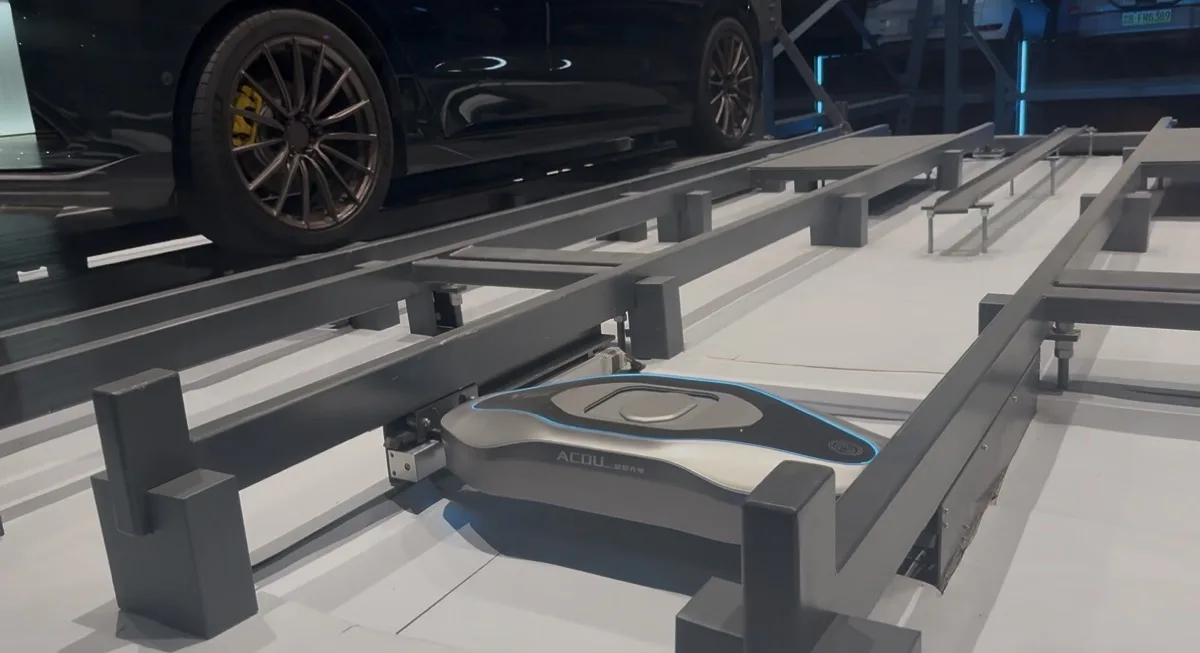
A rail-mounted ACDU unit positioned beneath a stored vehicle, ready to serve any bay along its row.
The AI. A cloud, edge and machine architecture coordinates the whole cycle: the cloud layer allocates buffer bays and stacking positions across the facility and builds an arrival-prediction model per vehicle, so a bay is already staged for departure before the request is made; the edge layer handles real-time machine vision, positioning correction and live status with no dependency on network connectivity; the machine layer executes the physical cycle.
The land does double duty: parking and storage
Because every bay in the stack can charge independently and automatically, a StackCharge facility isn't just dense parking with chargers attached. It's a distributed energy asset. Vehicles sitting in the stack overnight, or between shifts, can be charged and discharged through the same automatic connector as part of a V2X strategy: drawing power when it's cheap or abundant, and feeding it back when it isn't. The same square metre of land is working two jobs, parking revenue and grid-services value, rather than one.
Where a StackCharge site is paired with rooftop solar, a combination we already deliver for depot sites elsewhere in our portfolio, see our work on solar, storage and depot charging, on-site generation feeding directly into the ACDU network reduces how much of every charging session has to be bought from the grid. We're not going to put a headline percentage on that saving here: it depends on the site's solar yield, tariff, and how the fleet actually charges, and we'd rather model it properly for a specific site than quote a number that doesn't hold up under scrutiny.
Engineered for trust, not just throughput
UK operators don't need reminding why car park fire safety matters. In October 2023, a fire that started in a single vehicle on one level of Luton Airport's multi-storey car park spread to damage or destroy over 1,300 vehicles and brought down part of the structure. The car park had no sprinkler system to contain it. The vehicle at fault was a diesel Range Rover with an electrical fault, not an EV. The lesson wasn't about battery risk specifically; it was about what happens when a multi-storey car park has no way to stop one vehicle fire from becoming the whole building's problem.
A robotic parking structure holding several tonnes of vehicle weight and live battery packs has to earn its safety case before it earns its density numbers. StackCharge's fire-safety system runs four layers: bay-level smoke and temperature detection with a 3D water-mist curtain that contains a fire to a single vehicle; continuous monitoring of 36 fault models across the charging terminal and battery management system; automatic transfer of an at-risk vehicle to a fire-suppression pool within 60 seconds of a warning; and graded water immersion that escalates automatically to full immersion on a flame or explosion signal.
That system has been through 21 full-scale vehicle burn tests and over £1.1m in fire-test R&D. Neutron Systems is working with UK certification bodies to align StackCharge's fire engineering with BS 9999 and Approved Document B ahead of UK deployment.
Vehicle handling is built to the same standard: no barriers, no pallets, no repositioning, and a maximum vehicle weight of 3 tonnes, covering every full-size SUV and MPV sold in the UK. AI security monitoring covers the full facility around the clock, flame and smoke detection, person-down detection, unauthorised charging, connector-return checks, with automatic escalation by phone, SMS, on-site announcement or immediate power cut-off, and no on-site attendant required.
What UK operators should be asking
- How much of your site's value is currently lost to ramps, aisles and single-level parking?
- Is your charging capacity competing with your parking capacity for the same square metre?
- Would your electricity costs benefit from combining on-site generation with automated, scheduled charging rather than driver-initiated charging at unpredictable times?
- Does your operation include, or plan to include, autonomous vehicles that need to complete a full duty cycle, including parking and charging, without human intervention?
If a vehicle can already drive itself, there's no reason it should still need a person to park it or plug it in. Neutron Systems is bringing that platform to the UK.
Frequently Asked Questions
What is StackCharge?
StackCharge is a robotic high-density parking system with fully automated EV charging built into every bay. It is delivered exclusively in the UK by Neutron Systems, the UK technology partner of TGOOD Group.
Has a fully driverless park-and-charge cycle been achieved commercially?
Yes. A fleet of driverless logistics vehicles already completes an entire cycle, route completion, autonomous return, robotic parking and automatic charging, with no human involvement at any stage. As far as we're aware, this is the first commercial deployment of its kind anywhere in the world.
How much parking density does StackCharge add compared to a standard car park?
Up to 4 times the parking density of an equivalent surface car park, using dual-side, dual-position storage across a three-tier prefabricated stacking frame.
Can a StackCharge site generate value beyond parking revenue?
Yes. Because every bay charges through an automatic connector, parked vehicles can be used as part of a V2X strategy, drawing from on-site solar or off-peak power and discharging back when useful, turning the same footprint into both a parking asset and a distributed energy asset.
Why does car park fire containment matter, even for non-EV incidents?
The 2023 fire at Luton Airport's multi-storey car park, which damaged or destroyed over 1,300 vehicles, was started by a diesel vehicle with an electrical fault, not an EV, and spread because the car park had no sprinkler system to contain it. StackCharge's bay-level fire detection and containment is designed to stop a single vehicle fire, of any fuel type, from becoming a whole-building event.
Bringing StackCharge to the UK
Neutron Systems is taking expressions of interest for the first UK StackCharge deployment. Contact us to discuss whether your site fits.
View Smart Park & Charge