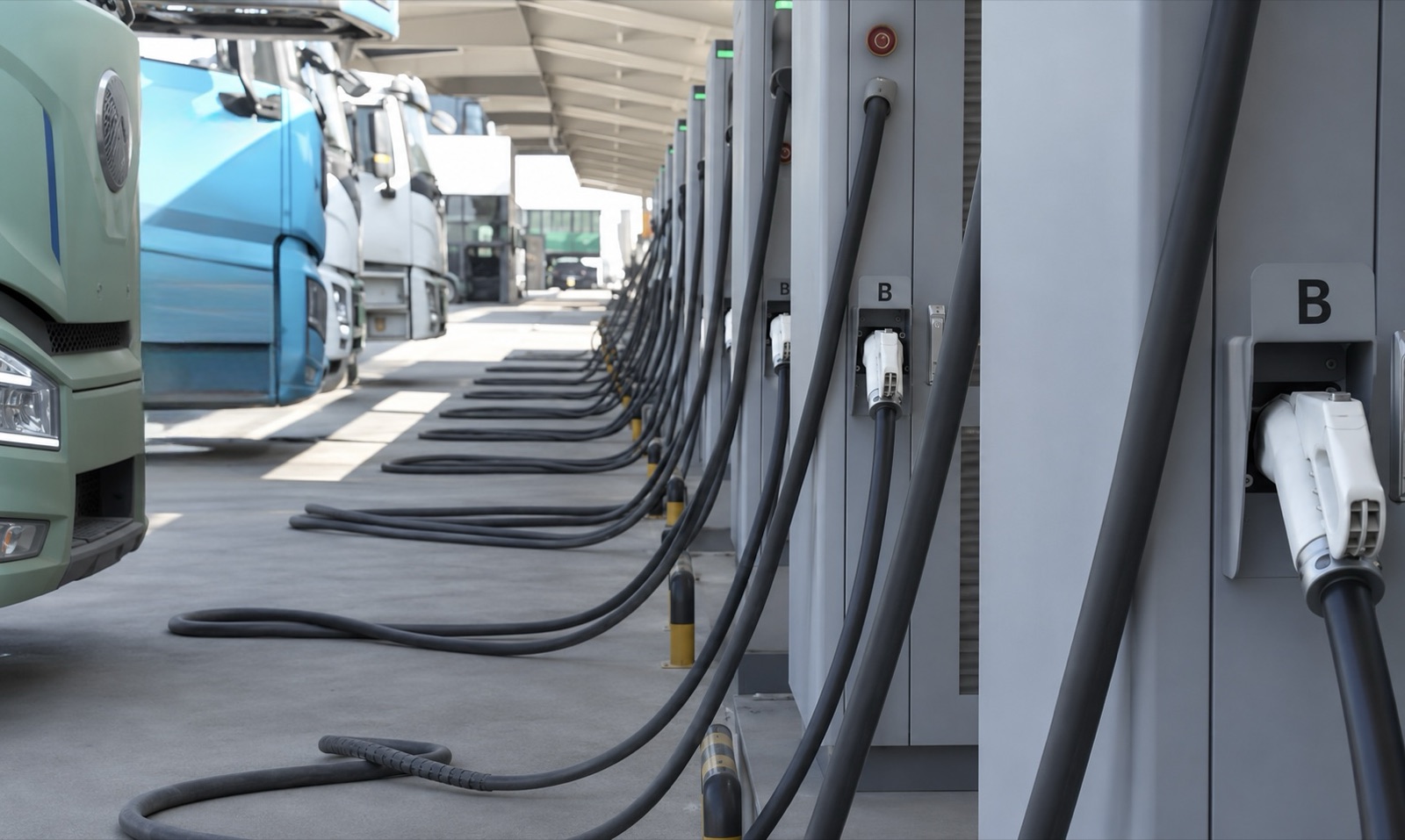
Every bus and heavy truck depot operator specifying DC depot charging infrastructure faces the same architectural decision, and it is rarely explained clearly before the order is placed: should each bay have its own self-contained integrated charger, or should the whole site run from a shared power pool distributed across a master unit and satellite terminals? Get it wrong and the mistake is not cosmetic. Oversizing the wrong architecture, or picking hardware that cannot keep pace with next year's trucks, can cost tens of thousands of pounds, and on larger sites well over £100,000, in wasted equipment or grid capacity that was never needed.
Neither architecture is universally correct. The right answer depends on budget, on how predictable the vehicle fleet is, and on how much spare capacity the local grid connection actually has. Here is how to work through it properly.
What Integrated (All-in-One) Chargers Do Well
An integrated DC charger houses its own power electronics, its own connector, and its own controls in a single self-contained cabinet. There is no shared power pool and no dependency on a separate master unit: the charger is rated at a fixed output, and it delivers that output reliably. A 240kW integrated unit that is installed and commissioned correctly delivers 240kW to a compatible vehicle, consistently, for the life of the equipment. That reliability, combined with a simpler bill of materials, is what makes integrated chargers cheaper to buy and straightforward to install: there is no power-sharing logic to configure, no satellite terminal wiring, and no master unit commissioning step.
For a depot with a small, fixed fleet and a firm budget ceiling, this simplicity is a genuine advantage, not a compromise.
The Problem: Trucks Change Faster Than Fixed Hardware Can Follow
The constraint that catches most operators out is not technical failure. It is obsolescence. Heavy vehicle charging requirements have moved fast: 240kW dual-gun was the mainstream specification for new HGV charging installations only two or three years ago, and it is now considered undersized for current-generation trucks. A depot specifying chargers for a 320kWh-battery truck this year may be serving a fleet running 400kWh-plus batteries next year, and the charger installed today has no path to deliver more power tomorrow. It is a fixed box with a fixed rating.
The commercial consequence is not abstract. An operator cannot justify replacing a charger a year after buying it. But a charger that takes noticeably longer to fill a newer truck than a competitor's site does is a charger that drivers and fleet operators start avoiding. Slow charging at a public or semi-public HGV site is not just an inconvenience: it is lost throughput, lost revenue, and a depot that quietly stops being anyone's first choice.
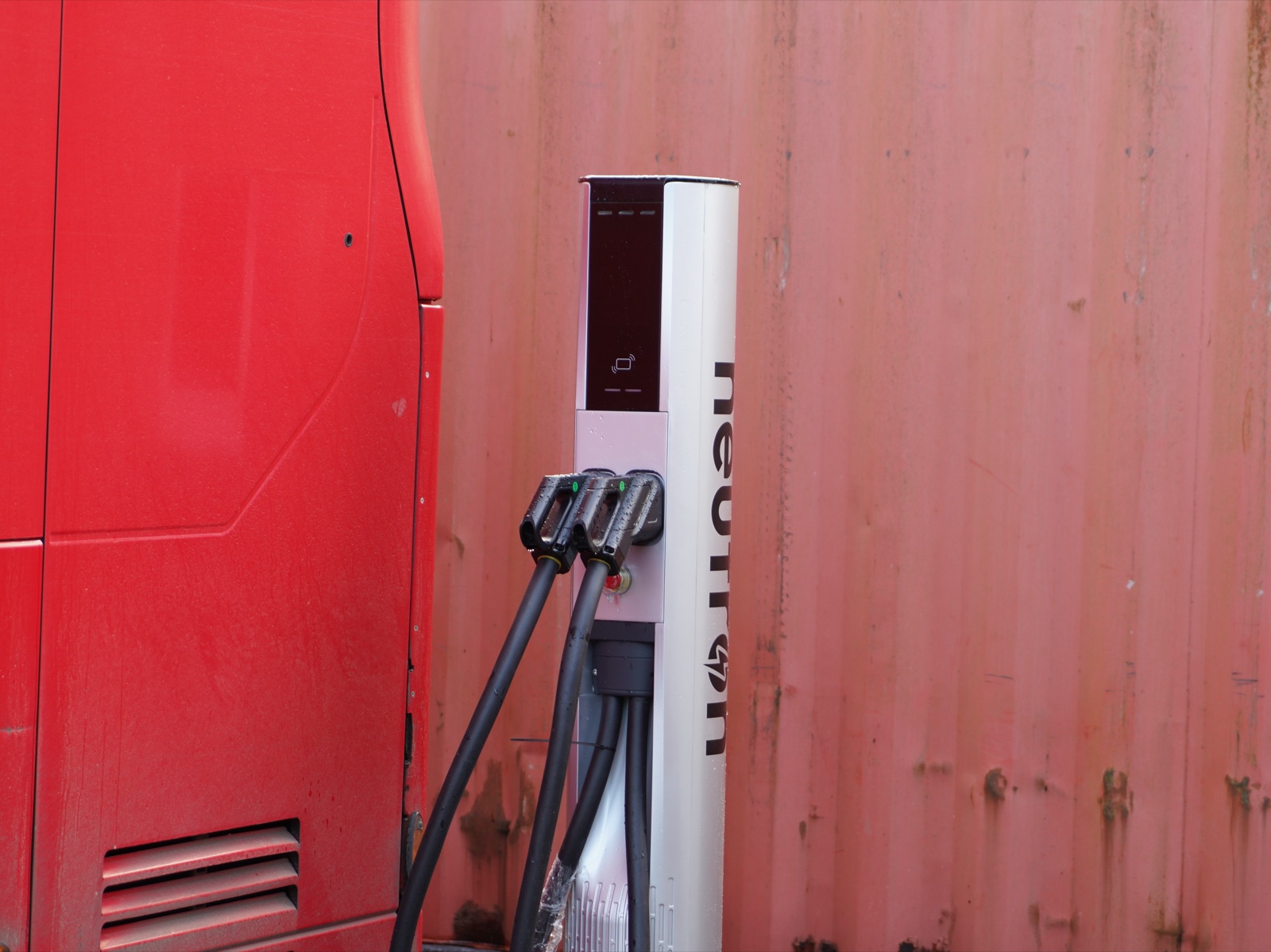
A satellite terminal serving a truck bay. The terminal itself carries no fixed power rating of its own — power is allocated from the shared master unit pool according to what the connected vehicle can accept.
The Second Problem: Paying to Provision Power You Rarely Use
The second constraint is on the supply side, and it is a capacity-planning problem, not a reliability problem. An integrated charger's power module serves its own bay only: it cannot lend spare capacity to the bay next door, even at 3am when that bay is empty. Every bay's peak demand has to be provisioned for independently, which means the site's grid connection and transformer have to be sized for the sum of every charger's nameplate rating, all firing simultaneously, even though that scenario is rare in practice.
A concrete example: an 8-bay bus and heavy truck depot fitted with eight 400kW dual-gun integrated chargers needs a transformer sized for 3,200kVA to cover the theoretical worst case of all eight running at full power at once. The same 8 bays served by a shared-power master-satellite system drawing from a 2.5MW pool needs only around 2,500kVA, because the pool allocates power dynamically to whichever bays are actually charging at any given moment, rather than reserving a fixed block per bay. The shared-power system also has a clear upgrade path to megawatt charging (MCS); the fixed-rating integrated chargers do not.
On some sites, the available grid capacity simply will not stretch to the integrated-charger number. In that situation the choice is not really a preference: a shared-power architecture is the only one that fits within what the DNO connection can actually supply, and it very often works out significantly cheaper on the grid connection and transformer costs than the equivalent block of integrated chargers, before even counting the ability to add power for higher-rated trucks later.
Where Integrated Chargers Are Still the Right Call
Integrated, self-contained chargers make sense where three conditions hold together: the budget is genuinely constrained, the vehicle fleet using the site is fixed and known in advance (a private fleet returning to its own depot every night, not a mixed public clientele), and the site is not expected to serve significantly more powerful vehicles within the equipment's service life. Under those conditions, the lower purchase price and simpler installation are a real saving, not a false economy, because the constraint that makes shared-power architecture valuable (unpredictable, evolving vehicle demand) simply does not apply.
Where Shared-Power (Master-Satellite) Architecture Wins
A shared-power system, what Neutron builds as the Modular Group Charging System, inverts the integrated charger's constraints. Power is not fixed per bay; it is allocated on demand from a shared pool of power modules housed in a master unit. A vehicle that needs 200kW gets 200kW. A vehicle that needs 400kW gets 400kW, drawn from the same pool, at the same time, without either connection being artificially capped by a fixed per-bay rating.
This adaptability is what makes shared-power architecture suited to a full-scenario depot: a site serving a mixed fleet, a public or semi-public HGV charging hub, or any operation where the vehicle mix five years from now is not fully known today. When higher-power vehicles arrive, the response is to add or upgrade a satellite terminal or a master unit power module, not to replace the entire installation. The Master Unit and satellite terminals are commissioned once; capacity is added incrementally as the fleet's requirements grow.
The trade-off is upfront cost. A shared-power system with a master unit and satellite terminal architecture costs more to purchase and install than the equivalent number of integrated chargers, and that additional equipment cost is the price of the flexibility described above.
How to Decide
| Situation | Recommended architecture |
|---|---|
| Limited budget, fixed and known fleet, self-use depot only, ample grid capacity | Integrated (all-in-one) chargers |
| Mixed or public-facing fleet, evolving vehicle mix, growth expected | Shared-power Master-Satellite (MGCS) |
| Grid or transformer capacity is constrained | Shared-power Master-Satellite — usually the only architecture that fits |
| Genuinely undecided between the two | Default to shared-power. The upfront premium is smaller than the cost of hardware that cannot keep up with next year's trucks. |
The pattern across all four rows is the same: integrated chargers win on cost and simplicity when the future is predictable. Shared-power architecture wins on adaptability when it is not, and for most depots planning to operate for a decade or more, some part of that future is unpredictable by definition.
Frequently Asked Questions
Should a bus or truck depot use integrated chargers or a modular shared-power system?
It depends on budget, fleet predictability, and grid capacity. Integrated (all-in-one) chargers suit depots with a limited budget, a fixed and known vehicle fleet, self-use only, and ample grid capacity. A modular shared-power (master-satellite) system suits mixed or public-facing fleets, sites expecting growth, or sites with constrained grid capacity. If genuinely undecided, default to shared-power: the upfront premium is smaller than the cost of hardware that cannot keep up with next year's trucks.
How much transformer capacity does an 8-bay heavy truck depot need?
An 8-bay depot fitted with eight 400kW dual-gun integrated chargers needs a transformer sized for 3,200kVA to cover the theoretical worst case of all eight running at full power simultaneously. The same 8 bays served by a shared-power master-satellite system drawing from a 2.5MW pool need only around 2,500kVA, because power is allocated dynamically to whichever bays are actually charging rather than reserved as a fixed block per bay.
Why do integrated DC chargers become outdated quickly?
Heavy vehicle charging requirements have moved fast: 240kW dual-gun was the mainstream specification for HGV charging only two or three years ago and is now considered undersized. An integrated charger is a fixed box with a fixed power rating and no path to deliver more power as newer, higher-capacity trucks enter service, unlike a modular system where capacity can be added incrementally.
What is a shared-power master-satellite EV charging system?
A shared-power master-satellite system distributes power from a shared pool of power modules housed in a master unit across multiple satellite terminals at each bay, allocating power on demand rather than fixing a rating per bay. A vehicle needing 200kW gets 200kW; a vehicle needing 400kW gets 400kW from the same pool. Neutron's Modular Group Charging System scales from 240kW to 960kW using this architecture.
240–960kW MGCS Master-Satellite Architecture MCS-Ready CCS2Not Sure Which Architecture Fits Your Depot?
Send us your bay count, expected fleet mix, and available grid capacity. Our engineering team will model both architectures against your actual numbers before you commit to hardware.
Talk to the fleet team