A smart overnight tariff can charge an EV at home for as little as 6.7-10p/kWh. Pull into a public rapid or ultra-rapid charger in 2026 and the same electricity costs 65-85p/kWh: on a 60kWh car, roughly £4-5 to fill up at home against £45-55 on the public network. That's not a rounding difference. It's close to a tenfold gap, and it's widening, not closing.
Most coverage of that gap treats it as a consumer story: charge at home if you can, budget for it if you can't. It's also an infrastructure story, and the part that gets skipped is the one that matters for anyone specifying a charging site: a public CPO, a depot operator, or an investor underwriting either. Who actually can't charge at home, and how that population is changing, says more about where charging demand is headed than almost any other single data point in the market.
Why the Gap Exists: It's Not the Electricity
UK non-domestic electricity runs around 23.8p/kWh. That's not what's driving a home tariff to 9p and a public rapid to 75p. Four things are layered on top, and they land on public charging almost exclusively.
VAT is the cleanest example: 5% on domestic electricity, 20% on public charging, a gap sometimes called the "pavement tax" because it falls hardest on drivers who have no choice but to use the street network. A tribunal ruling that could equalise the two rates is currently under HMRC appeal; 20% remains in force in the meantime. Standing charges for rapid and ultra-rapid connections are up 462% since 2021/22 and now account for as much as 70% of a rapid site's total energy cost, according to Cornwall Insight analysis commissioned by ChargeUK. Transmission charges (TNUoS) for large-demand sites are rising a further 64% from April 2026. And underneath all of it, a public site is carrying hardware amortisation, land lease, grid connection cost and operating overhead that a home wallbox simply never has to recover.
| Cost layer | Home charging | Public rapid/ultra-rapid |
|---|---|---|
| VAT | 5% | 20% |
| Standing charge trend since 2021/22 | Broadly stable | +462% |
| Transmission charges (TNUoS) | Not applicable at household scale | +64% from April 2026 |
| Capex to recover | One wallbox, self-installed cost | Grid connection, hardware, land, ongoing opex |
| Typical 2026 price | 6.7-10p/kWh off-peak | 65-85p/kWh |
The Driveway Divide: Who Actually Pays the Premium
RAC Foundation analysis puts it at roughly 65% of British households (18 million of 27.6 million) with enough off-street parking to accommodate at least one car or van. That leaves 35% of households with no realistic way to charge overnight except the public or on-street network, and the distribution is far from even: in dense boroughs like Tower Hamlets, as few as 7% of residents have access to a driveway. DfT's 2024 overnight parking data tells a similar story from a different angle: 9% of household vehicles parked in a garage, 64% on private property but not garaged, 25% on the street, 3% elsewhere.
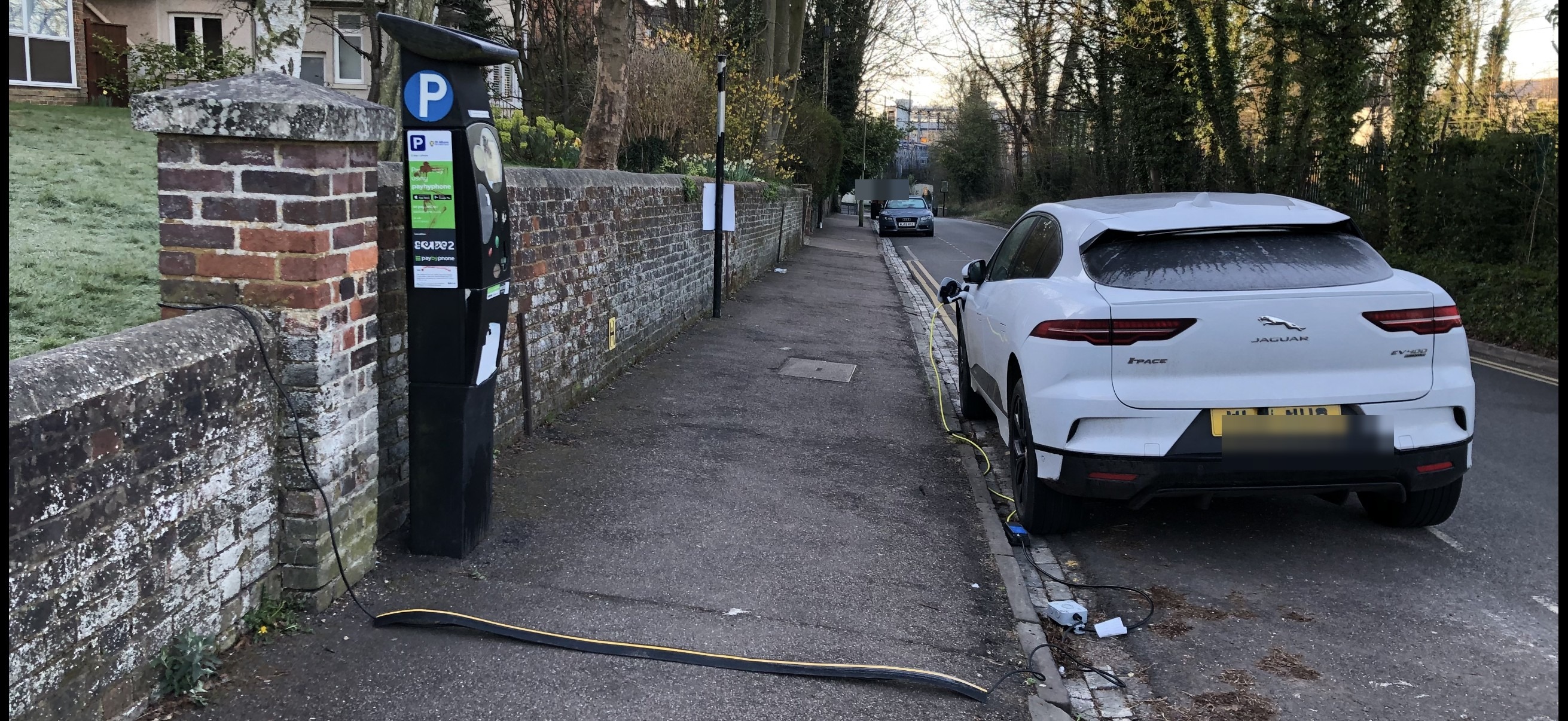
On-street charging in practice: a cable run across a public pavement to a kerbside charge point, the reality for the roughly one in three UK households without a driveway.
This isn't just a convenience gap. It's a cost gap with a geography and, by extension, an income and housing-tenure pattern attached to it: renters, flat residents and terraced-street households are disproportionately the ones paying 65-85p/kWh for something a driveway-owning neighbour pays 9p for. A cost structure that charges the group least able to install their own infrastructure the highest marginal rate is, by definition, regressive. It's one of the reasons the VAT-equalisation case matters beyond its headline percentage.
The 80% Statistic Is Measuring the Wrong Population
It's widely cited, including in our own coverage of why UK charging operators are struggling, that roughly 80% of current EV owners have home charging access. That figure is accurate as far as it goes, but it describes today's EV owners, not the UK population, and those two groups are not the same. Early EV adoption has skewed heavily toward homeowners with driveways: higher household income, suburban and semi-rural housing stock, exactly the segment RAC Foundation's 65% off-street parking figure already over-represents relative to renters and flat-dwellers.
Put the two numbers side by side and the gap is the story. If 65% of all UK households have off-street parking, but 80% of current EV owners charge at home, the EV-owning population is charging at home at a materially higher rate than the general housing stock would predict. That's a selection effect, not a steady state. As adoption spreads (which it has to, for the ZEV Mandate to be met), it spreads into exactly the households the early-adopter base under-represents: renters, flat residents, terraced streets without driveways. The home-charging share among EV owners should structurally fall as the market matures, not hold at 80% indefinitely.
The correction this implies: public and depot charging demand is being systematically underestimated by the 80%-charge-at-home figure, not overestimated. The addressable market for public charging isn't a fixed 20% of drivers: it's a share that grows as EV ownership moves down-market into housing types where a driveway was never an option.
What This Means for Public and Depot Charging Economics
This matters directly for the utilisation problem covered in our analysis of why UK charging operators keep losing money: UK public chargers are active roughly 8% of the day on average, well below the 50%+ utilisation a rapid site needs to be commercially healthy. Some of that gap is genuinely structural: too many chargers for today's demand. But if the addressable population without home charging is set to grow rather than stay fixed at "the 20% who don't currently own EVs and lack a driveway," then a chunk of today's under-utilisation is a timing problem, not a permanent one. Sites specified to serve tomorrow's driver mix, not today's, are the ones positioned to catch that demand as it arrives: the same future-proofing argument that applies to hardware power ratings applies to how big a market an operator is underwriting.
For depot and fleet operators specifically (buses, HGVs, last-mile vans), the read-across is different but related. Depot charging isn't paid for by an individual driver choosing between 9p and 75p; it's a fleet operating cost that flows into freight rates and service contracts. But the same cost stack (standing charges, TNUoS, VAT on the commercial connection) sits underneath depot economics too, and it's the same lever that closes part of the consumer-side gap: what an operator does with idle capacity and off-peak power.
Storage-Backed Tariffs: Closing Part of the Gap
A site paying standing charges around the clock but only serving vehicles for a fraction of the day is carrying pure cost the rest of the time, whether it's a public rapid hub or a depot bay. Battery storage changes that calculation: buy power off-peak, discharge it during expensive periods or peak driver demand, and the operator is no longer paying commercial peak rates for every kWh it sells. Several UK operators are already using this to fund discounted off-peak tariffs in the 50s (p/kWh) rather than the 70s or 80s, still well above a home tariff, but a meaningful narrowing, and one the operator controls without waiting on a VAT ruling or a DNO upgrade.
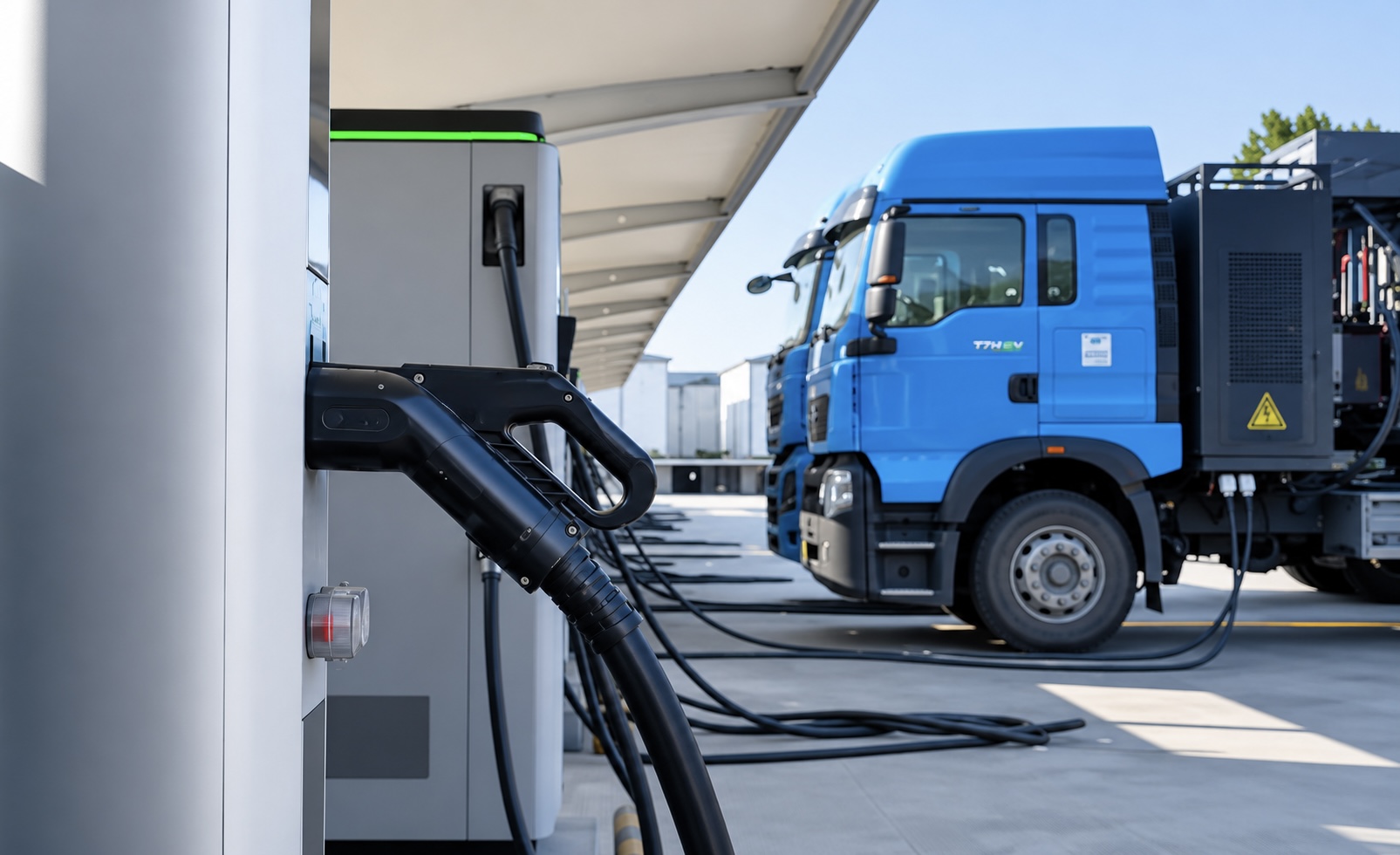
HGV depot charging in practice: the kind of site where an off-peak, storage-backed tariff turns idle overnight capacity into a funded discount instead of a pure standing-charge cost.
This is the same logic covered in more depth in our look at BESS versus grid-only fleet charging and the four-year payback model for solar-storage depot sites: storage doesn't erase the VAT gap or reverse the standing-charge increases, but it's the one part of the cost stack an operator can actually redesign around, rather than lobby for. For a depot investing in charging infrastructure today, sizing the grid connection and storage layer around this (not just around today's vehicle count) is what turns idle overnight capacity into a genuine tariff advantage instead of a stranded cost, covered in our grid connection and storage architecture guide for fleet depots.
How Neutron Builds Around This
Every depot engagement starts with the same question this article is really about: who is this site actually going to serve, at what utilisation, and on what tariff, three to five years from now, not on day one. Where a site can support it, Power Hub and Power Plant battery storage turns overnight idle capacity into a funded off-peak tariff rather than a pure standing-charge cost, and the Electron platform manages pricing and utilisation across the site as that demand curve shifts. It's the same modular, storage-backed architecture behind the Master Unit depot deployments already running UK bus and HGV sites today.
Frequently Asked Questions
Why is public EV charging so much more expensive than home charging in the UK?
Because almost nothing about the price is the electricity itself. Home smart tariffs run as low as 6.7-10p/kWh overnight, while public rapid and ultra-rapid charging runs 65-85p/kWh in 2026. The gap comes from VAT (5% at home versus 20% in public), standing charges on rapid connections that are up 462% since 2021/22, rising transmission charges, and the land, hardware and operating costs a public site has to recover that a home wallbox never carries.
What percentage of UK households have a driveway or off-street parking?
Around 65% (18 million of 27.6 million households), according to RAC Foundation analysis, with big regional variation: as low as roughly 7% of homes in dense boroughs like Tower Hamlets. The remaining 35% of households have no realistic way to charge an EV overnight without using the public or on-street network.
Does the "80% of EV charging happens at home" statistic apply to all drivers?
No. It describes the current population of EV owners, which skews heavily toward homeowners with driveways because that is who adopted EVs first. The general UK household off-street parking rate is only around 65%, well below the 80% figure. As adoption spreads into renters and urban households without a driveway, the home-charging share among EV owners should structurally fall, meaning public and depot charging demand is being systematically underestimated by the 80% figure rather than overestimated.
Can battery storage make public and depot charging cheaper?
Yes, partially. Battery storage lets an operator buy power off-peak and discharge it during expensive periods, or fund a discounted tariff, without paying peak commercial rates for every kWh sold. It doesn't remove the VAT or standing-charge gap, but it is the main lever an operator actually controls to narrow the price a driver pays without needing a policy change.
BESS-Backed Sites Off-Peak Tariff Arbitrage Master-Satellite Architecture Grid-First DesignModel Your Site's Tariff Economics Before You Commit to Hardware
Send us your site, expected utilisation and vehicle mix. Our engineering team will model a storage-backed tariff strategy alongside the grid connection plan, so idle capacity funds the site instead of costing it.
Talk to the engineering team