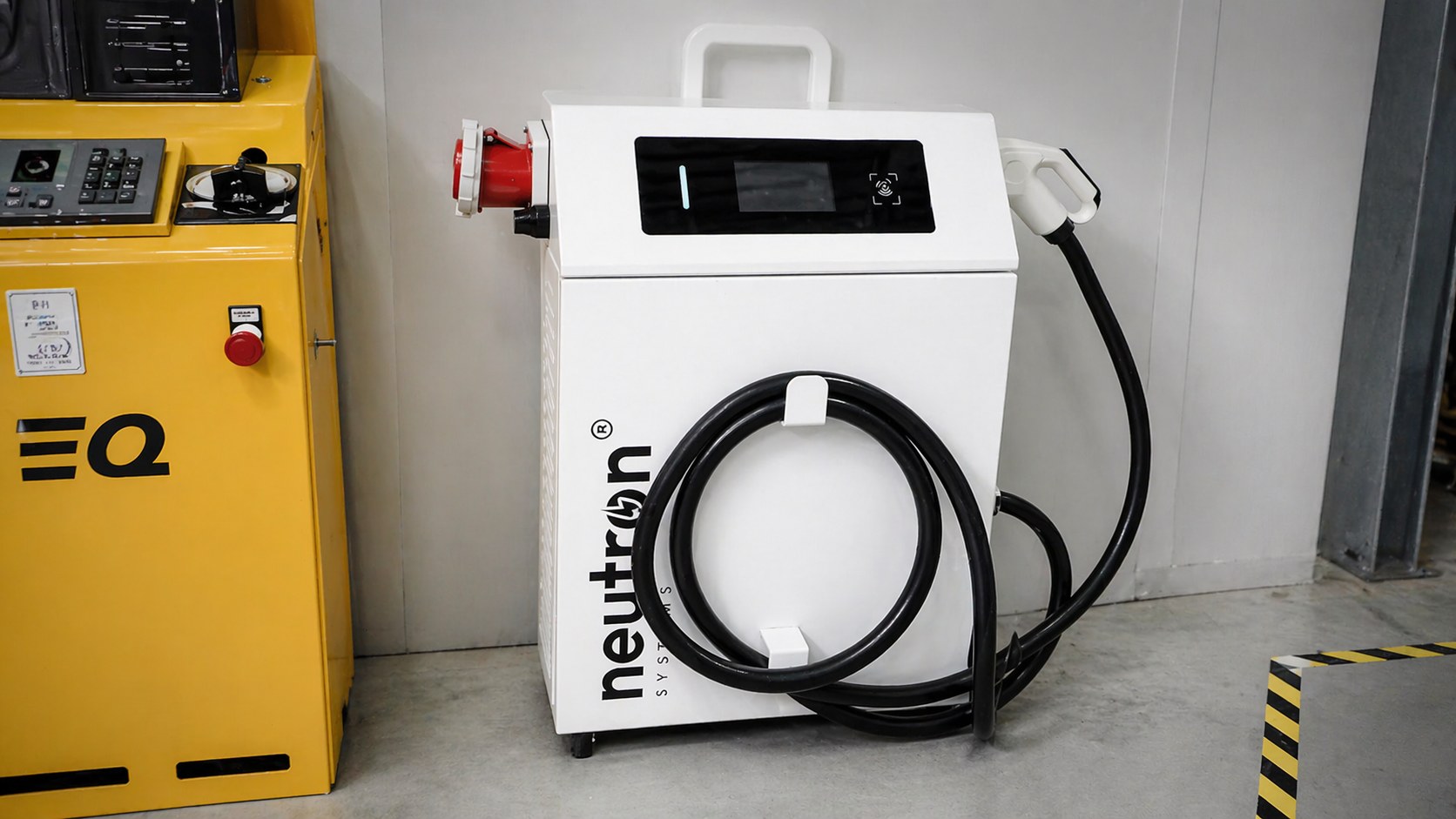
Getting an electric vehicle charged quickly when there is no fixed infrastructure at your location is one of the most practical barriers the industry rarely discusses. A depot waiting on its DNO connection. A demonstration arranged at a client's yard. A construction site running electric plant before the permanent supply arrives. A bodyshop that services EVs three days a week but cannot justify the disruption of a fixed installation.
These are situations where a fixed DC charger is the wrong answer: not because the technology is wrong, but because the timeline is wrong. A 40kW portable DC charger changes the calculus. It plugs into the three-phase industrial supply that exists at virtually every commercial and industrial site in the UK, and it is charging within minutes of arrival.
The Infrastructure Gap No One Plans For
DNO connection timescales for new or upgraded EV infrastructure in the UK currently range from six to eighteen months in congested areas. Civil works for a fixed DC charger (trenching, groundwork, installation inspection) add weeks on top of that even after the connection is confirmed. For an operator running electric vehicles now, that gap is not an abstraction: it is a daily operational problem.
The portable DC charger exists specifically for that gap. It requires no DNO application, no civil works, no installation sign-off, and no dedicated circuit. It connects to a CEE 32A or 63A three-phase socket (the standard industrial supply found on the wall of almost any warehouse, depot, workshop, or site distribution board) and delivers DC fast charging at up to 40kW directly to the vehicle.
The key distinction: AC charging from a three-phase supply requires the vehicle's onboard charger to do the AC-to-DC conversion, which is typically limited to 11kW or 22kW and takes hours. A portable DC charger does the conversion itself and feeds DC directly to the battery: the same principle as a fixed rapid charger, in a unit you can move between sites.
Supporting BYD's UK Demonstration Programme
One of the clearest illustrations of where portable DC charging earns its place is in vehicle demonstration programmes. When an EV manufacturer arranges to demonstrate a zero-emission bus or coach at a transport authority's depot, a council yard, or a fleet operator's compound, the site will almost certainly have three-phase industrial power, but it will almost certainly not have a DC fast charger.
Neutron Systems supplied a 40kW portable DC charger to BYD's UK operations to support exactly this requirement. BYD's electric buses are routinely demonstrated to prospective customers at their own premises: driver familiarisation sessions, range assessment runs, technical evaluations with the operator's engineering team. A day's demonstration draws down the battery. The vehicle needs to be charged before the next session, or before returning to base. Installing a fixed charger at every prospect location is impractical. Hiring a mobile DC charging service introduces cost and scheduling dependency. A portable charger that travels with the demonstration programme solves the problem directly.
The unit plugs into the site's existing industrial supply at the beginning of the demonstration day and is ready to top up the vehicle between sessions without any preparation or specialist involvement. When the programme moves to the next site, the charger moves with it.
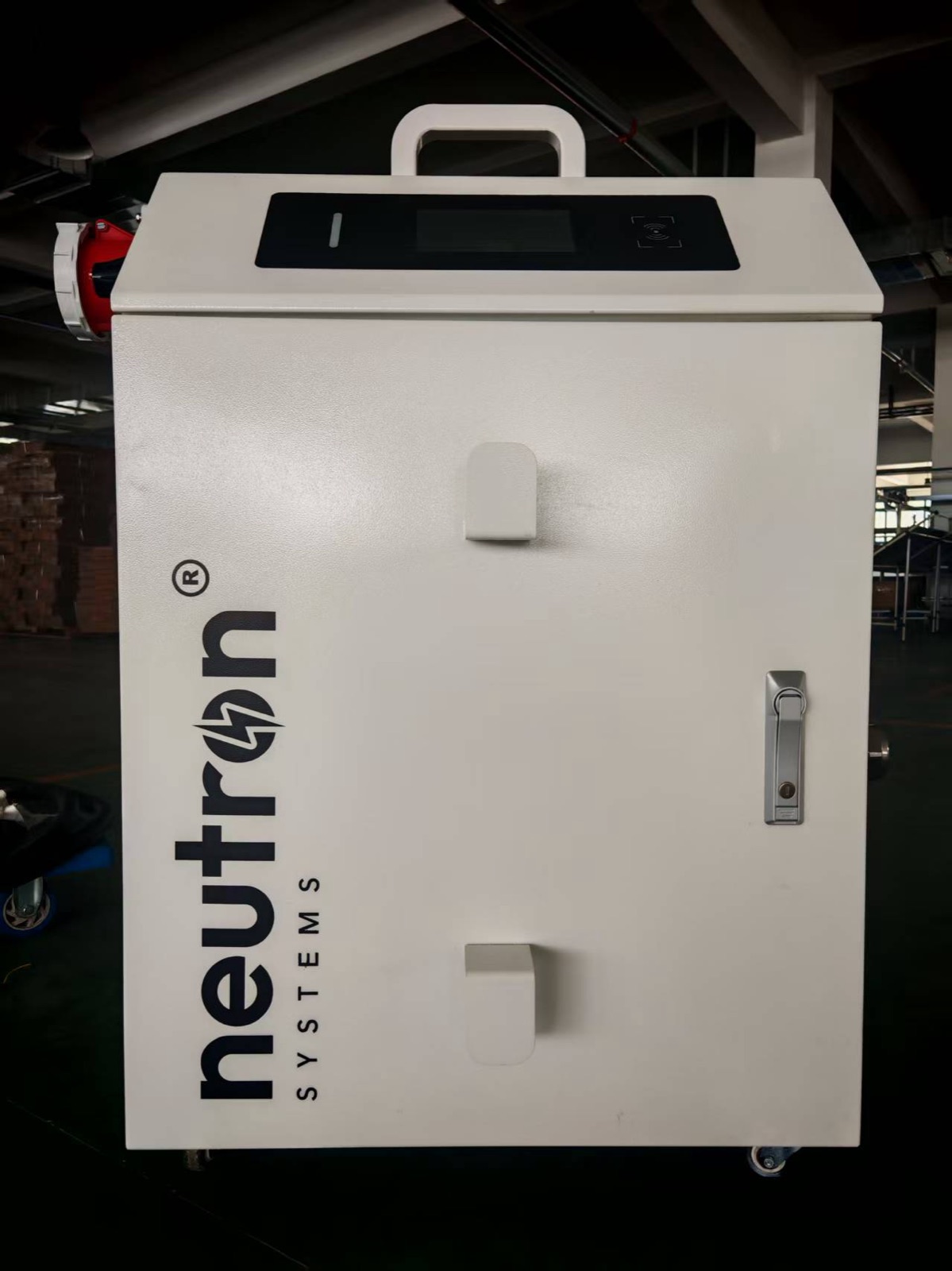
The Neutron NSNF0042 as it leaves final assembly. Carry handle, onboard touchscreen, RFID reader, lockable cabinet, and castor wheels for one-person deployment between sites.
Customer Trial Vehicles and Leasing Fleets
The same logic applies across a wider set of vehicle manufacturers and leasing companies that operate trial and demonstrator fleets. An electric van or car on a four-week customer trial needs to be charged at the customer's premises. If the customer has not yet installed a DC charger, overnight AC charging from a domestic or light commercial socket will charge the vehicle slowly enough that the trial does not reflect real-world fast-charging capability.
A portable DC charger can be supplied to the customer for the duration of the trial alongside the vehicle. It connects to whatever three-phase supply is available at their premises and gives the customer a genuine DC charging experience rather than a constrained one. For manufacturers trying to convert trial customers to orders, demonstrating the full capability of the product (including how quickly it charges) is not a minor detail.
Exhibitions, Trade Shows, and Temporary Sites
Motor shows, transport industry exhibitions, and outdoor demonstration events face a version of the same problem in its purest form: the venue is temporary, the electrical supply is whatever the event organiser has provisioned (usually three-phase distribution for lighting and stands, rarely a DC charger), and the vehicle on the stand needs to arrive and leave under its own power, charged. Installing fixed charging infrastructure for a three-day exhibition is not an option under any circumstances, yet the charging requirement is real: press days, VIP drive events, and live demonstrations all draw down the battery, often several times in a single day.
A portable DC charger is built for exactly this pattern of use. It travels with the stand build, connects to the venue's existing three-phase supply, and is struck down and packed away with the rest of the exhibition kit at the end of the show. The same unit that charged a demonstration bus at a bus depot on Monday can be at a trade show floor charging a display vehicle on Wednesday, with no infrastructure left behind at either site.
Construction Sites: Power Today, Permanent Infrastructure Later
Modern construction sites increasingly operate electric equipment. Groundworkers' vans, site managers' vehicles, compact electric plant, and delivery vehicles all need charging. The permanent grid connection to the completed development is typically months away from being commissioned. The electric vehicles are on site today.
A construction site's temporary electrical supply, typically a 63A three-phase socket on a site distribution board or generator, is precisely the input the portable charger is designed to accept. The unit charges vehicles from that supply at DC speeds throughout the working day and can be moved between locations as work progresses across the site. No civil works, no ground-breaking, no separate application to the project's DNO connection agreement.
For larger sites with multiple charging requirements, the portable charger also functions as a test bed: operators can assess actual on-site demand before specifying permanent infrastructure, ensuring the fixed installation is sized to reflect reality rather than a theoretical estimate.
EV Maintenance, Bodyshops, and Mobile Technicians
The workshop and service environment presents a specific challenge. An EV that arrives for bodywork or mechanical inspection may need to be driven on and off ramps, moved between bays, and tested under power repeatedly. An AC wall socket charges it at 7kW; that is an acceptable overnight rate but a slow result during a working day. A fixed DC charger at a specific bay removes the flexibility to move the vehicle or work across different bays.
A portable charger resolves both constraints. It rolls to whichever bay the vehicle occupies, connects to the three-phase supply at that bay, and charges at 40kW while the technician works. When the vehicle moves to the next bay, the charger moves with it. For workshops that service EVs regularly but not exclusively, a portable unit serves the same function as a fixed charger without tying up a specific bay or requiring the EV to be moved to a dedicated charging point.
Mobile technicians (ADAS calibrators, software update specialists, and warranty engineers who attend customer sites rather than receiving vehicles at a workshop) face the same problem at every customer location. The portable charger is a tool they can carry and deploy on-site, regardless of what charging infrastructure the customer has installed.
How It Connects: CEE Input, CCS Output, OCPP Ready
The portable charger accepts input from a standard CEE 3-phase industrial socket: the red round connector (pictured above, mounted directly on the cabinet) found on site distribution boards, generator outputs, and three-phase supplies in workshops, depots, and warehouses across the UK. No specialist wiring is required at the supply point, and no new circuit needs to be installed. The 40kW unit draws 62A at 400V through this connector; standby consumption when idle is under 30W. If the site has a 32A or 63A three-phase supply, it has what the charger needs.
Built into a galvanised, powder-coated steel enclosure measuring 1150 × 690 × 400mm and mounted on locking castors, the unit is IP54 rated: protected against dust ingress and splashing water from any direction, appropriate for outdoor depot yards, exhibition sites, and construction compounds. Full electronic protection is built in, covering over/under-voltage, surge, overload, short circuit, earth leakage, and over-temperature, and the unit carries CE and UKCA certification for deployment across the UK and EU.
On the vehicle side, the charger delivers DC via a CCS2 (Combined Charging System) connector, compatible with the full range of electric cars, vans, buses, and coaches using the European DC fast charging standard. The output is controlled by the same communication protocol (ISO 15118 / DIN 70121) as any fixed rapid charger. Charge rate limits, state of charge targets, and session authorisation all work the same way the vehicle expects from a permanent installation.
The unit also supports OCPP 1.6 and OCPP 2.0.1, allowing it to be connected to the Electron CMS or any third-party charge management platform. Sessions are metered, authenticated via RFID card or app, and reportable: the same audit trail as a fixed installation, from a unit that can be on a different site each week.
For operators that need to track energy consumption on a temporary deployment (billing demonstration mileage back to a vehicle manufacturer, reporting charge sessions during a customer trial, or monitoring construction site energy use), OCPP connectivity means the portable charger is a managed asset, not an untracked appliance.
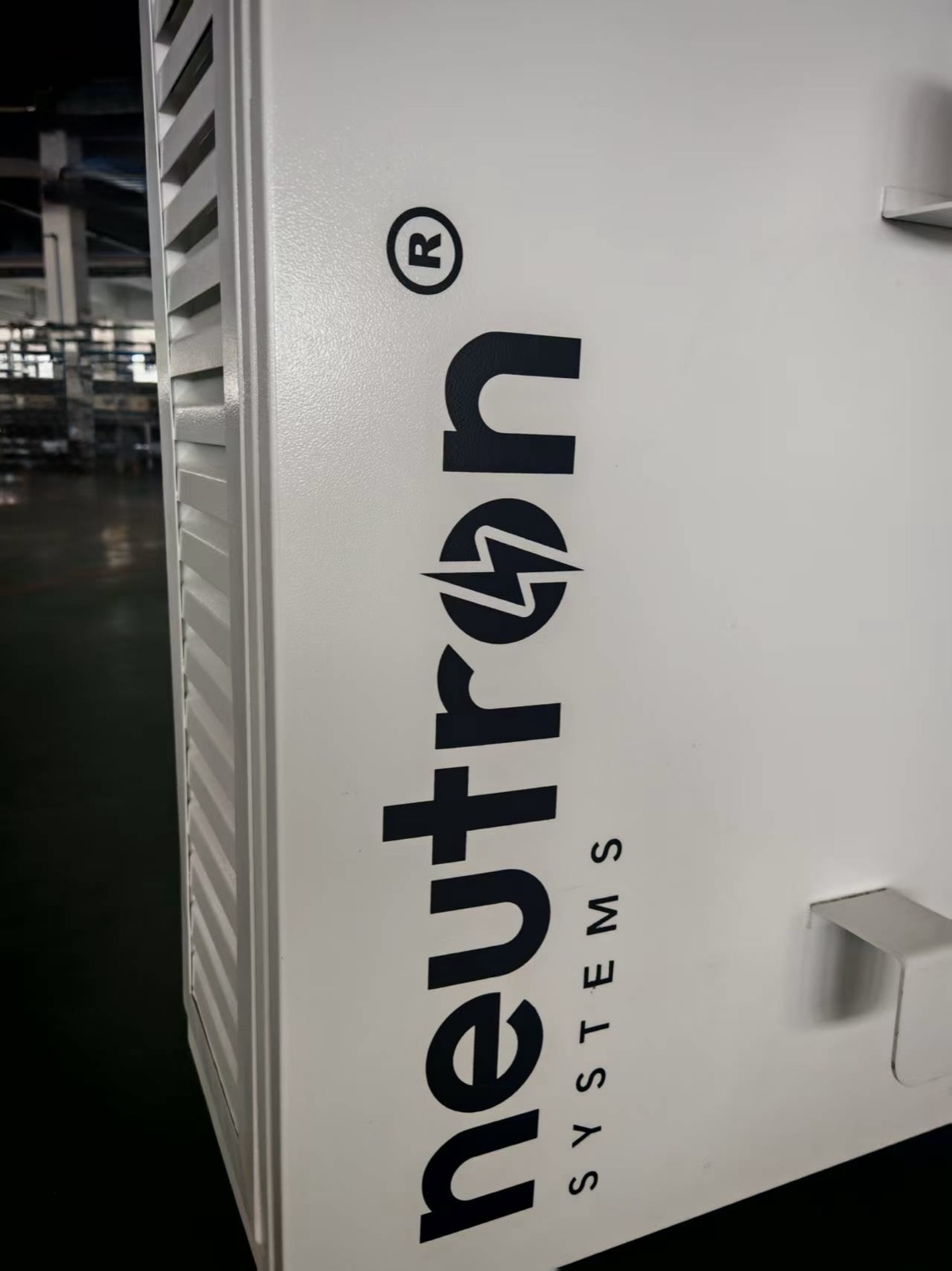
Side ventilation panel. The unit is rated for continuous 40kW output without active cooling: thermal management is handled passively through the louvred enclosure.
Frequently Asked Questions
Can a portable DC charger really deliver 40kW without any installation?
Yes. The Neutron NSNF0042 plugs into a standard CEE 32A or 63A three-phase industrial socket, the type already present on most UK commercial and industrial sites, and delivers DC fast charging at up to 40kW with no DNO application, civil works, or dedicated circuit required.
What input power does a portable DC charger need?
A standard three-phase CEE industrial socket rated at 32A or 63A at 400V, the same connector found on site distribution boards, generator outputs, and workshop or warehouse power supplies across the UK.
How is a portable DC charger different from charging from a normal AC socket?
AC charging relies on the vehicle's onboard charger to convert AC to DC, which is typically limited to 11kW or 22kW and takes hours. A portable DC charger performs the AC-to-DC conversion itself and feeds DC directly to the battery, the same principle as a fixed rapid charger, in a unit that can be moved between sites.
Can a portable DC charger be used for vehicle demonstrations or trade shows?
Yes. Vehicle manufacturers use portable DC chargers to support demonstration and trial programmes at customer depots, and at exhibitions and trade shows where fixed charging infrastructure cannot be installed. The unit connects to whatever three-phase supply the venue provides and travels with the vehicle or stand to the next site.
40kW DC Output CCS2 CEE 3-Phase Input OCPP 1.6 / 2.0.1 No Installation RFID & App AuthNeed DC Charging Without the Wait?
Whether you're running a demonstration programme, bridging a grid connection delay, or need charging flexibility across multiple sites, our commercial team will match the right unit to your use case.
View Portable Charger Specs