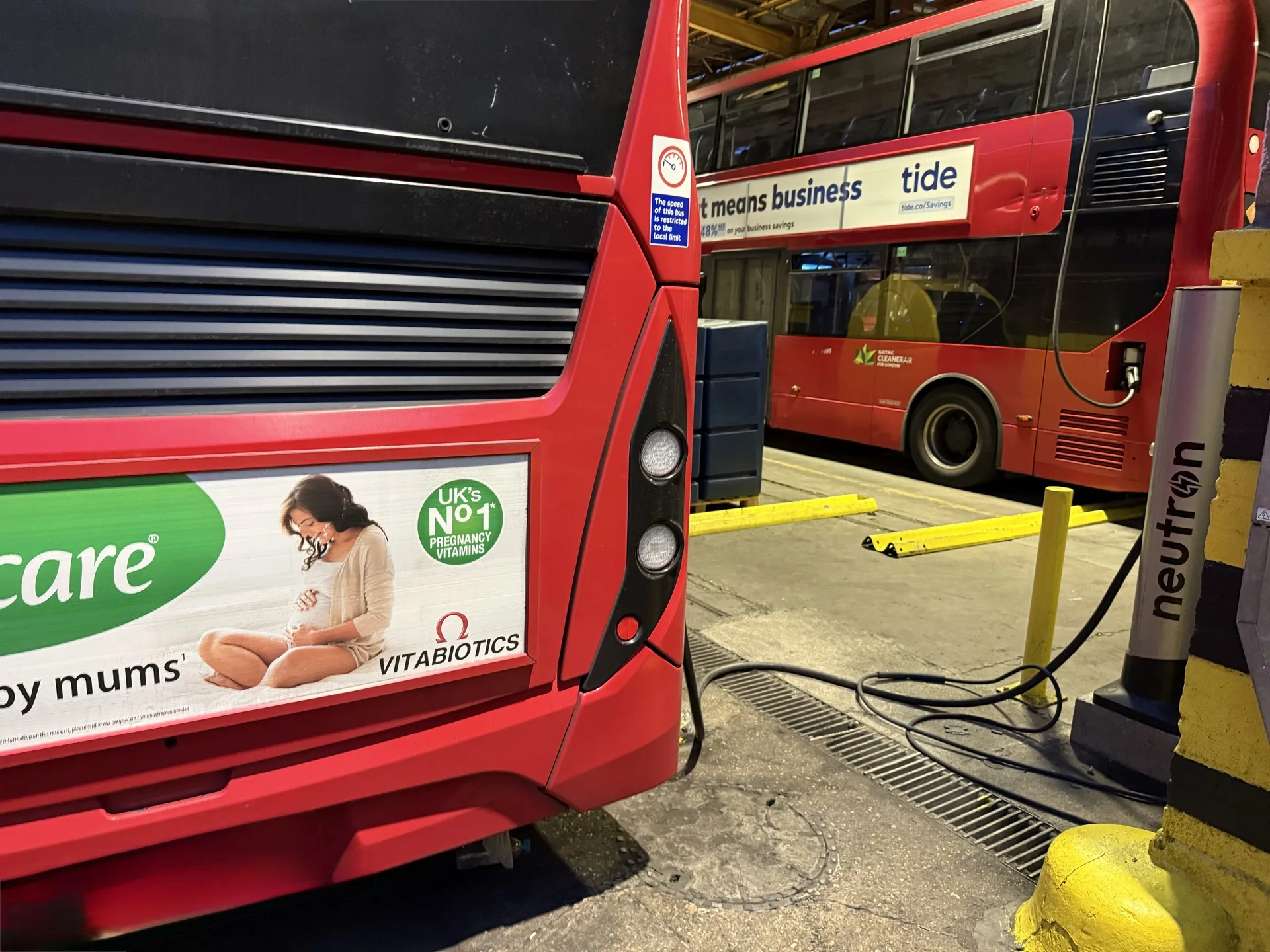
Fleet operators electrifying in 2026 have access to multiple overlapping grant schemes, but the window is narrowing. Three government programmes are active simultaneously, each targeting a different operator type. The right combination can fund 50–75% of a depot's total infrastructure cost. The wrong approach (applying for one scheme when you qualify for two) leaves substantial money unclaimed.
This guide covers every active scheme, who qualifies, how much is available, and the sequencing that makes stacking work.
OZEV Depot Charging Scheme Window 1 closed 30 June 2026. Window 2 opens 28 October 2026. LEVI Fund and ZEBRA 2.0 remain active throughout. Contact Neutron to prepare your Window 2 application.
The 2026 Funding Landscape
The UK's fleet electrification grant environment in 2026 is more complex and more generous than at any previous point. OZEV, Innovate UK, and local transport authorities are all running overlapping programmes, and the interaction between them is poorly understood by most fleet procurement teams. Operators who engage with funding specialists or experienced infrastructure suppliers at the start of a project consistently secure better outcomes than those who discover the schemes after procurement has begun.
Three programmes covered fleet operators in 2026. The OZEV Depot Charging Scheme is the largest in absolute terms; its first window closed in June 2026, and a second window opens 28 October 2026. The LEVI Fund targets a specific operator type: logistics and last-mile delivery, with terms that complement rather than duplicate the OZEV scheme. ZEBRA 2.0 is reserved for bus and coach operators and is structured differently from the other two, covering both vehicles and infrastructure from a single application.
Understanding which scheme applies to your fleet, what it covers, and how it interacts with the others is the starting point. The sections below address each in turn.
OZEV Depot Charging Scheme: Window 1 Closed, Window 2 Opens 28 October
The Depot Charging Scheme, administered by OZEV (Office for Zero Emission Vehicles), is the most significant fleet infrastructure grant available in the UK, running as a £170 million multi-year programme through 2030. Window 1 (25 March – 30 June 2026) funded up to 70% of eligible capital costs, with a maximum grant of £1 million per organisation from a £28 million pool. Window 2 opens 28 October 2026 and closes 29 January 2027, with £38 million available for projects starting April 2027; the funding rate and terms for Window 2 are still to be confirmed by OZEV.
What the OZEV scheme covers
Eligible costs include DC chargers, energy management systems, battery energy storage systems integrated with the charging infrastructure, associated civil works, and project management costs within defined limits. The scheme is designed for depot infrastructure rather than on-street or public charging, and the technical standards require OCPP 2.0.1 compliance and smart charging capability as baseline requirements.
The inclusion of BESS as an eligible cost is significant. Battery storage integrated with the charging system (rather than deployed as a standalone energy asset) qualifies under the scheme. For operators facing grid constraints, this dramatically improves project economics: the storage that allows the depot to charge without a costly DNO upgrade is itself substantially grant-funded.
Who qualifies
UK-registered fleet operators with five or more commercial vehicles are eligible. The scheme covers depots charging electric vans, trucks, buses, or coaches. Equipment must meet OZEV technical standards, and the grant offer letter must be issued before procurement; operators cannot buy equipment first and claim retrospectively.
What is not covered: standalone energy storage not connected to the charging system, vehicle costs, land acquisition, and planning costs. If your project has a significant standalone BESS component (for grid services or trading rather than depot charging): that portion will not be fundable under this scheme, though the charging-integrated storage portion may still qualify.
The application process
Operators submit a project outline and cost schedule via the OZEV portal. Scheme administrators review the submission, confirm eligibility, and issue a grant offer letter before the operator proceeds to procurement. Equipment must be purchased and installed after the offer letter is received, not before. The cost schedule submitted at application stage defines the eligible cost basis, so accuracy at that stage is important.
What that meant in practice, based on Window 1's 70% rate and £1M cap:
| Scenario | Installed Cost | 70% Grant | Your Net Cost |
|---|---|---|---|
| 10-bay AC logistics depot | ~£80,000 | £56,000 | £24,000 |
| 20-bay DC fleet depot | ~£400,000 | £280,000 | £120,000 |
| 50-bay bus garage | ~£1,200,000 | £840,000 | £360,000 |
Grants are capped at £1M per organisation across all sites.
Window 2 opens 28 October 2026 and closes 29 January 2027, with £38 million available for projects starting April 2027. OZEV has not yet confirmed the funding rate for Window 2; Window 1 offered 70% funding at a £1M cap. Contact Neutron to prepare your Window 2 application.
LEVI Fund: For Logistics and Last Mile
The Local Electric Vehicle Infrastructure (LEVI) Fund targets commercial van and light goods operators: logistics companies, courier networks, and last-mile delivery operators with mixed DC/AC charging requirements. Where the OZEV Depot Charging Scheme is structured primarily for high-power DC-only installations, LEVI is better matched to the mixed charging infrastructure that characterises logistics depots: a combination of fast DC chargers for larger vans and slower AC units for car fleets and smaller vehicles.
Key LEVI Fund terms
The fund provides up to £75,000 per eligible site and covers mixed AC/DC charging installations from 7 kW up to 200 kW. It is available to SMEs and fleet operators with fewer than 250 employees at a single site. Critically, LEVI can be combined with the OZEV Depot Charging Scheme at the same site, subject to subsidy control rules, meaning eligible logistics operators can access both programmes simultaneously.
Unlike the Depot Charging Scheme, LEVI does not have a publicly announced hard close date for 2026. However, the fund operates by round, and the current round is oversubscribed in some regions. Operators considering LEVI should apply promptly; the fund operates by round and regional allocations can be exhausted.
For logistics operators with dual DC/AC requirements (for example, 100 kW DC for a mid-size van fleet plus 22 kW AC for a car fleet or manager vehicles), the LEVI structure is often better matched to the infrastructure mix than the OZEV scheme alone. The two schemes address different cost components of the same project, which is why they can be combined without violating state aid rules.
ZEBRA 2.0: For Bus and Coach Operators
The Zero Emission Bus Regional Areas (ZEBRA) scheme is reserved for local authority and public transport operators procuring zero-emission buses. It is the only active grant that funds both vehicles and depot infrastructure from a single application, making it structurally different from the other two schemes and particularly significant for operators who are at the vehicle procurement stage.
What ZEBRA 2.0 funds
ZEBRA 2.0 grants cover up to 50% of the incremental cost of a zero-emission bus fleet versus an equivalent diesel fleet. Charging infrastructure at the depot is a funded component within the bus grant application; operators do not submit a separate infrastructure claim. Applications are consortium-based: bus operators typically apply alongside their local transport authority, and the consortium structure is a scoring criterion in the evaluation.
The depot charging specification is a material component of a ZEBRA 2.0 bid. Scheme evaluators assess infrastructure readiness alongside vehicle specification, financial viability, and network coverage. A credible depot charging plan (including a site survey, power capacity analysis, and charge management system proposal with OCPP 2.0.1 compliance) improves bid scores. An underdeveloped infrastructure section is a common reason for strong bus-side bids to score below the threshold.
Bus operators who have not yet begun a ZEBRA 2.0 application should also be aware that the scheme is competitive. Bid development takes time, and the infrastructure specification is not a last-minute addition; it needs to be developed alongside the vehicle procurement process, not after.
Stacking Grants: What's Allowed
UK subsidy control rules (governed by the Subsidy Control Act 2022, which replaced the EU state aid framework after the end of the transition period) limit how grants can be combined. The headline principle is that total public funding across all schemes cannot exceed the eligible cost of the funded activity. In practice, this means that stacking is possible, but the arithmetic must be checked for each specific project.
What the rules allow in practice
The OZEV Depot Charging Scheme (70% of eligible infrastructure cost under Window 1) can be combined with the LEVI Fund (up to £75,000) at the same site, provided total grant does not exceed 100% of the eligible cost for the same line items. ZEBRA funding for identical equipment items would be subject to OZEV scheme exclusions; operators considering both ZEBRA and OZEV funding for the same infrastructure components should confirm the interaction with scheme administrators before applying to both.
Revenue-based support (such as demand flexibility payments via the National Grid ESO, or grid balancing revenues from a BESS) does not count against capital grant limits. An operator who receives OZEV grant funding for charging infrastructure can still participate in flexibility markets with that infrastructure without any clawback implications for the capital grant.
A worked stacking example
Consider a logistics operator with 40 electric vans and a 200 kW DC depot charging installation. Gross infrastructure cost: £180,000.
- OZEV Depot Charging Scheme at 70%: £126,000 grant
- LEVI Fund contribution: up to £75,000, but total grant cannot exceed 100% of cost. After OZEV, the remaining eligible cost is £54,000, so the maximum LEVI contribution at this site is £54,000
- Net operator cost after stacking: £180,000 − £126,000 − £54,000 = £0
Full funding is achievable for qualifying projects within the scheme caps. The arithmetic is project-specific: a larger installation with a gross cost above £250,000 would leave enough remaining eligible cost for the full £75,000 LEVI contribution. The principle is that understanding both schemes from the outset, and structuring the project specification accordingly, is what makes the difference between 70% funding and 100%.
The ZEV Mandate Context: Why 2026 Is the Right Year
The UK ZEV Mandate requires that 28% of new van sales in 2026 must be zero emission, rising annually to 70% by 2030 and 100% by 2035. For trucks and coaches, the trajectory is similar in shape if different in timing. OEM fines for non-compliance are structured to encourage early adoption by fleet buyers, as the economics of the mandate place increasing pressure on operators who delay procurement decisions.
For fleet operators, this creates a specific financial logic. Depots that secure OZEV support (70% under Window 1, rate to be confirmed for the 28 October Window 2) build the infrastructure at current prices under some of the most favourable funding terms available this decade. Depots that wait until 2028–2030 (when ZEV Mandate pressure is higher, procurement lead times are longer, and the grant landscape is unknown) bear more risk on capital cost, timeline, and competitive position.
Window 1 of the OZEV Depot Charging Scheme closed on 30 June 2026. Operators who entered the portal before the deadline locked in 70% capital cost coverage at 2026 prices. Window 2 opens 28 October 2026: operators should begin preparing their site survey, system specification, and cost schedule now, and explore LEVI and ZEBRA 2.0 in the interim.
Getting Grant-Ready
Applications to the OZEV Depot Charging Scheme require three components: a confirmed site survey, a system specification compliant with OZEV technical standards (OCPP 2.0.1, smart charging capable, with the charging management system specified), and a cost schedule from a qualified installer. The cost schedule is the document that defines the grant calculation; it needs to itemise eligible and non-eligible costs clearly, because the scheme administrators will review it.
The site survey establishes the existing grid connection capacity, identifies any constraint that a BESS could address, and confirms the physical layout for cable routing and charger placement. The system specification translates that site survey into a defined equipment list and architecture. The cost schedule prices it. These three documents are submitted together as the project outline.
Neutron's engineering team can produce all three as part of a pre-application assessment, typically within 10 working days. We have supported applications through the OZEV process and understand the documentation standard that the scheme administrators expect. The same package is also applicable to LEVI Fund and ZEBRA 2.0 applications.
Frequently Asked Questions
Is the OZEV Depot Charging Scheme still open in 2026?
Window 1 closed on 30 June 2026. Window 2 opens 28 October 2026 and closes 29 January 2027, with £38 million available for projects starting April 2027. Window 1 funded up to 70% of eligible infrastructure costs, with a maximum grant of £1 million per applicant from a £28 million pool; Window 2's funding rate is still to be confirmed by OZEV.
What grant funding is available for logistics fleet charging?
The LEVI Fund supports logistics and last-mile fleet charging infrastructure, with a maximum grant of £75,000 per logistics site.
What funding is available for bus and coach operators in the UK?
ZEBRA 2.0 (Zero Emission Bus Regional Areas) provides UK government grant funding for bus and coach operators transitioning to zero-emission fleets, matched by private capital investment.
Can UK fleet operators combine multiple grant schemes?
Some UK fleet electrification grant schemes can be combined depending on eligibility rules and funding source, but stacking conditions vary by scheme. Operators should check current scheme guidance and confirm eligibility before assuming multiple grants can be applied to the same infrastructure spend.
Plan your depot electrification with the right funding strategy.
LEVI Fund and ZEBRA 2.0 remain active. Neutron's team will assess your site, identify which schemes apply, and prepare your application documentation.
Request a funding assessment